
Is 2026 the Right Year to Apply for an MBA?

Every year the media declares it the hardest MBA admissions cycle ever, citing economic turbulence, rising applications, and global uncertainty. But those macro headlines don't determine whether an MBA will accelerate your career. 

Only one question actually matters: is this the right year for your pivot?

Table of Contents

Video version

Play Video

Why the macro picture is the wrong place to look

Applicant volumes fluctuate, but the number of strategic, well-positioned candidates stays roughly constant. Admissions committees are looking for fit and impact, not just filling seats from a large pool.

The moment you anchor your timing decision to headlines instead of your own trajectory, you've already started thinking about the wrong thing.

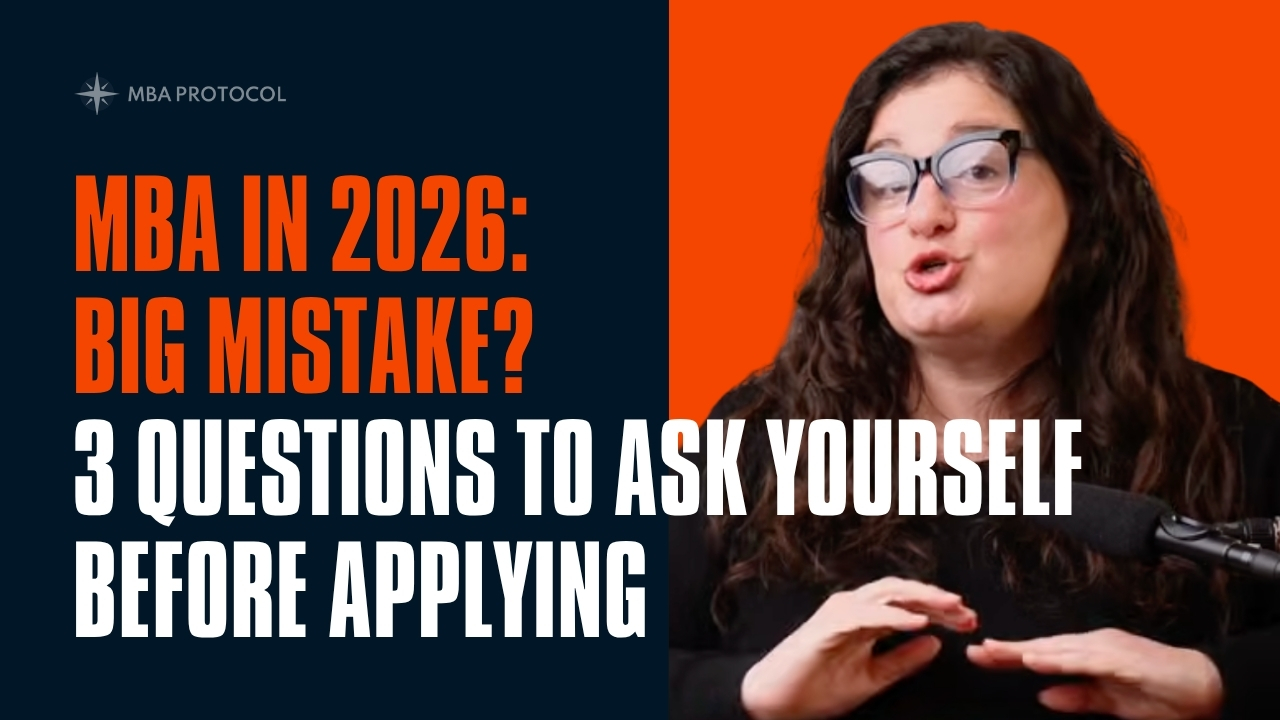
The three questions that cut through the noise

Answer each honestly. The pattern of your answers will tell you more than any ranking article or admissions forum ever could.

QUESTION 1

  • Do you know what you want?
  • Envision your life in three to five years. Where do you live? What does your role look like, and how do you feel about your trajectory? Can you picture it concretely?

If you can't, pause. Clarify your vision before committing to a degree that costs two years and six figures. An MBA is a tool, not a substitute for direction.

QUESTION 2

  • Will an MBA accelerate or enable that future?
  • Does a business degree make your desired outcome faster or more likely? Some transitions genuinely require it. Others simply don't, and pursuing one anyway means spending real time and money on something that won't change your outcome.

If the answer is no, the MBA may not be the right tool for this stage. Consider alternative pathways, or revisit in a year when your goals are sharper.

QUESTION 3

  • Have you extracted all valuable learning from your current role?
  • Have you built meaningful transferable skills; people management, project leadership, strategic thinking? Or do real growth opportunities still sit in front of you?

The answer shapes your timing more than anything else.

Apply now

You've reached a learning ceiling. Staying longer adds age to your profile, not relevant experience. A senior engineer looking to move into business strategy is a good example.

Wait 1–2 years

You still have concrete growth ahead; building a larger team, leading a cross-functional project. Use that time. It will make your application substantially stronger.

How to put this into practice

  1. Write down your three-to-five-year vision. A notebook, a Google Doc, anything. Just make it concrete and specific enough to pressure-test.
  2. Map your current skills against your target role. Where are the gaps? Does an MBA close them, or is there another way?
  3. Score the three questions honestly. Strong answers across all three points toward applying in 2026. Weak answers on any one of them suggest waiting and building.
  4. Get outside perspective. Peer feedback, alumni conversations, and a structured community can surface blind spots you won't catch alone. Have a free call with Angela or another MBA Protocol coach to get some clarity on this decision.

The verdict

There's no universal answer. But there's almost always a clear one, once you look honestly at your trajectory, your goals, and the role an MBA would actually play in getting you there.

Apply in 2026 if…

Your vision is clear, an MBA directly enables it, and your current role has taught you most of what it can. Your profile is ready.

Wait and build if…

Your goals need sharper definition, or you still have meaningful experiences to gain. A stronger application next cycle is worth the wait.

If you're still weighing the decision, the MBA Momentum Club is a free, structured community that helps you clarify your goals, assess your profile, and build a realistic strategy without the noise.

The right timing isn't about market headlines, it's about your personal vision, the value an MBA adds, and the learning you've already maximised. Decide with clarity by joining the MBA Momentum Club.

Frequently Asked Questions

Is 2026 a good year to apply to business school?

It depends on your personal situation, not the economy. If you have a clear goal and an MBA is the best way to reach it, 2026 is your year.

How do I know if I'm ready to apply for an MBA?

When you can picture a specific future you want, and an MBA is the most direct path to it. Vague ambition isn't enough.

Should I apply to an MBA during economic uncertainty?

Don't let the macro drive a personal decision. The strength of your reasoning matters far more than the admissions climate.

What are the most important factors in MBA timing?

Three things: a clear vision, an MBA that genuinely enables it, and a current role you've fully outgrown.

Is it worth waiting a year before applying?

Yes, if the extra time builds your profile; better leadership experience, sharper goals, a stronger GMAT. A deliberate delay is rarely a setback.

Does the admissions pool get harder in uncertain years?

Volumes fluctuate, but strong, well-positioned candidates face roughly the same standard every cycle.

What careers benefit most from a full-time MBA?

Major pivots into consulting, finance, tech strategy, or a new geography, where a top programme's network and recruiting pipelines genuinely accelerate the move.

What if I’m still not sure that now is the right time to apply?

That's exactly what the MBA Momentum Club is built for. It's a free community where you can pressure-test your goals, assess your readiness, and build a realistic plan; no coaching fees, no commitment. Join the MBA Momentum Club today.

Picture of Angela Guido

Angela Guido

Student of Human Nature| Founder and
Chief Education Officer of Career Protocol

All Posts

More Like This

Are MBA Alternatives Worth It?

You don’t need an MBA to grow your career. Learn practical, lower-cost ways to build business skills, expand your network, and create new opportunities without business school.