Part 1
The 5 questions, answered straight
You’re thinking about spending two years and a small fortune on an MBA, in the middle of an AI revolution, while the headlines tell you the jobs are disappearing. Of course you’re nervous. You should be asking hard questions.
I’ve spent 20 years helping people get into business school. This year my team and I pulled the employment data for 29 top U.S. programs and went through it number by number so you don’t have to. Below are the five questions I hear most, each with a straight answer, the data behind it, and what to do about it. It will take you about fifteen minutes. The rest of this report is backup for when you want to dig.
The short version
| The question | The straight answer | Your move |
|---|---|---|
| 1. Is the MBA still worth it? | Yes, for most of you. Grads are still getting hired and paid well. It costs more, and the job hunt takes longer than it used to. | Run your own numbers and go after scholarships. |
| 2. Which programs are worth it for my goals? | There is no best school. There’s the best school for the job you want. | Pick the job first. Then pick the schools that send people there. |
| 3. Will robots eat the MBA jobs? | Not most of them, and not first. The work MBAs get hired for is the work AI does least. | Aim for roles where you make the call, and get fluent in AI now. |
| 4. If I need a visa, can I still build a U.S. career? | Yes, under today’s rules. Those rules are moving, and we are not lawyers. | Choose a STEM program and target employers that sponsor. |
| 5. Is it harder to get in? | Yes, because far more people are applying. The scores you need haven’t changed. | Stop retaking the test and work on your story. |
1. Is the MBA still worth it?
Yes, for most of you. MBAs are still getting hired and still getting paid. It costs more and takes a little longer than it used to.
Let’s start with the fear, because it’s a fair one. You’ve read that AI can do the work of a first-year consultant, and you’re wondering whether anyone will still be hiring MBAs by the time you graduate. Here’s what happened to the class that just did.
The jobs are there. Three months after graduation, 85% of job seekers at the top 10 schools had accepted an offer. At the schools outside the top 10 it was 81%. The pay is there too. Average base salaries ran from about $121,000 to $190,000, and 18 of 28 schools came in above $150,000. That’s before any signing bonus.
Now the part most people won’t tell you straight. The market is softer than it was. Placement is down at 25 of 29 schools since 2023, and the schools outside the top 10 took the bigger hit, sliding from 92% to 81%. A lot of grads are now signing their offers in the summer after graduation, where they used to sign in the spring before it. That’s stressful. It’s also survivable if you plan for it.
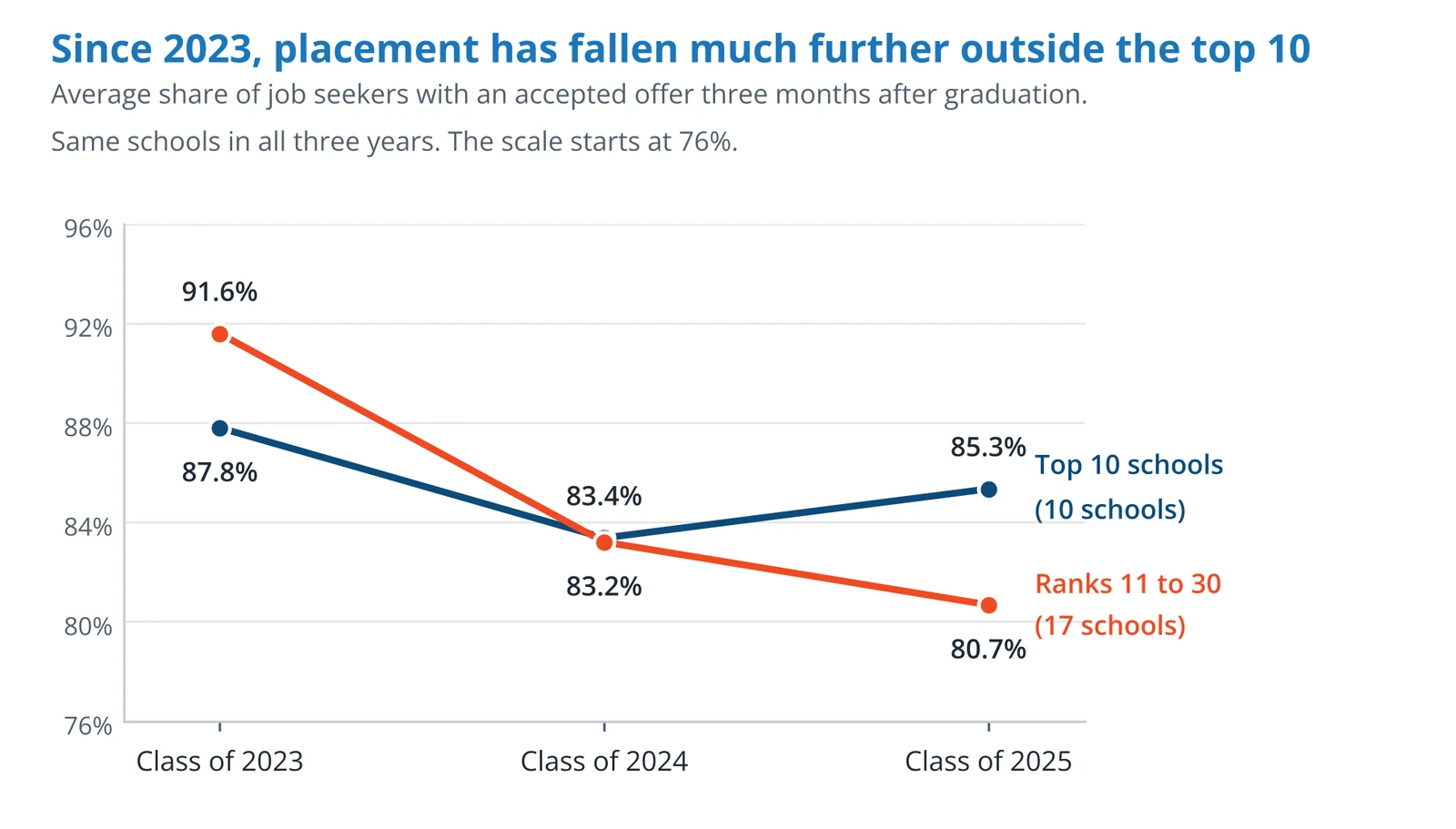
Share of job seekers with an accepted offer three months after graduation. Every school, year by year, is in the Chart Zone under Jobs and pay. This chart is Jobs 7.
And the cost? Brace yourself: 20 of these 29 top US schools charge at least $70,000 a year in tuition alone. But look at what comes back. At 24 of 28 schools, the average first-year base salary is bigger than two full years of tuition. The honest footnote is that this used to be an even better deal. Since 2001 the all-in cost of the degree is up about 160%. Starting pay is up about 90%.
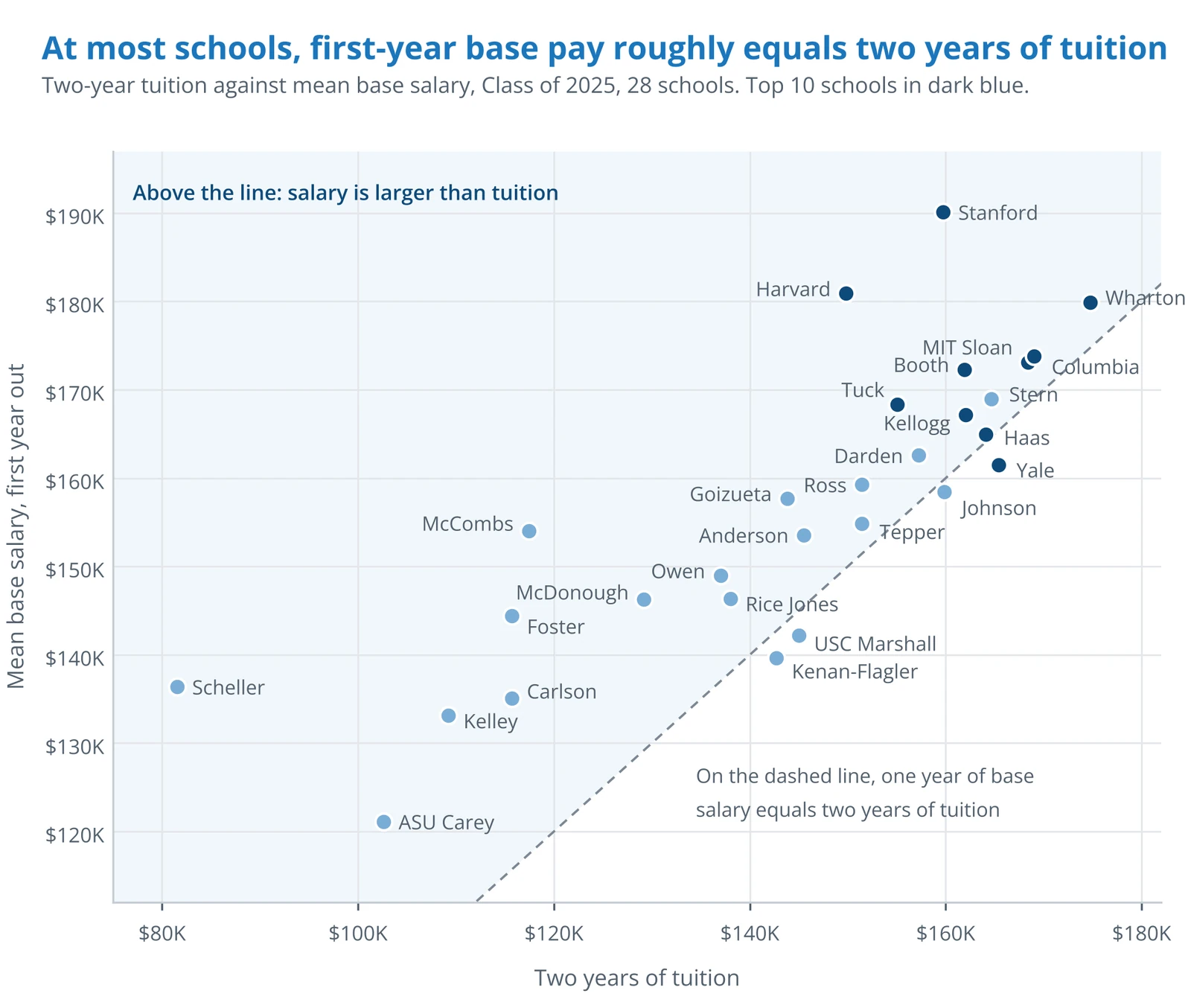
Two years of tuition against the average first-year base salary, Class of 2025. Tuition by school and the cost picture since 2001 are in the Chart Zone under What it costs. This chart is Cost 2.
Your move. Whether it’s worth it for YOU comes down to the gap between what you earn now and what you’d earn after. Run your own numbers. Our free ROI model in the MBA Momentum Club walks you through it. And go after scholarships like it’s your job. Our admitted clients have averaged $109,000 each over the last three years. Talk to us about how.