

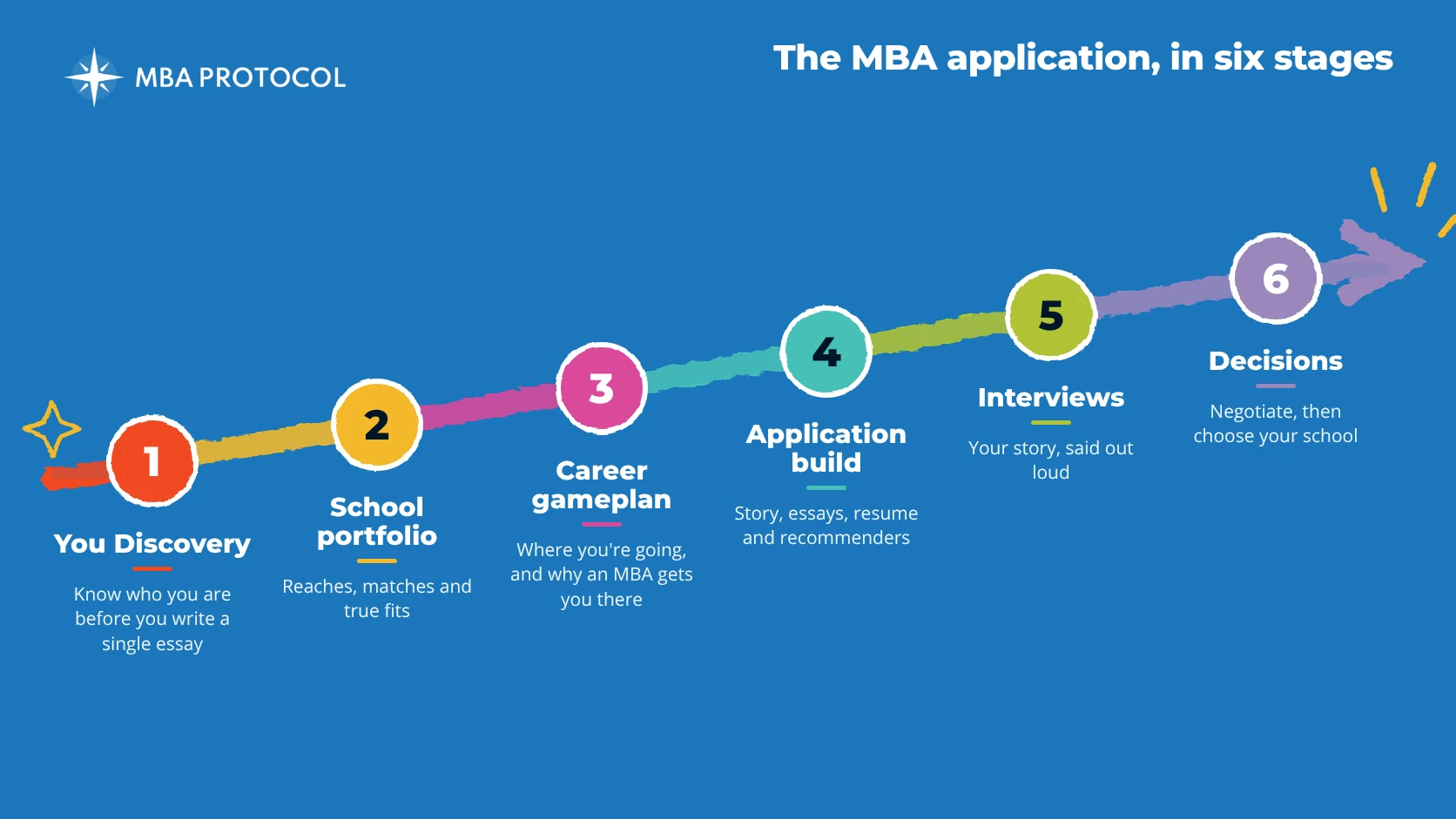

The MBA application process has six stages: You Discovery™, your school portfolio, your Career Gameplan™, the application build, interviews, and decisions. Most people treat it as a checklist (take the GMAT, write some essays, get some recommendations, submit) and jump in somewhere in the middle. The applicants who get into their dream schools, often with scholarships, go through the stages in order. The order matters more than you would expect, and the first stage changes everything that follows.
If you want the wider view first, start with our guide to getting into business school, then read how MBA admissions really works. This article is about how the process runs once you start.
Stage 1: You Discovery™ comes first
This is the foundation, and it is everyone’s favorite stage, coaches and clients alike. You Discovery™ is a structured, guided look at your own life: your upbringing, your education, your career, and the moments that shaped you. It takes about fifteen hours of work between you and your coach. You surface things you had forgotten. You see your own path through a new lens.
Then you share all of it with your coach, who reflects it back to you and points out the through lines, the patterns, and the things that make you distinctly you. Your essays, your resume, your recommendations, and your interviews all draw on this. Skip it, and every later document will fail to precisely reveal who you are.
You also get something besides material, and that is calm. The goal of the whole process is to reach the submit button knowing you told the story you wanted to tell, so that you can live with whatever comes back, including no.
Stage 2: Build a school portfolio you would be happy with at every tier
Once you know yourself well, you can work out which schools are right for you. This starts with where your statistics land on a chart. A good portfolio mixes reaches, schools where you are competitive, and schools where your statistics stand out. All of them should feel like a true fit. MBAmo gives you a first read on your odds. Your coach helps you see the risk in each choice, and the choices stay yours.
Most people apply to four to six schools. Aim to love every tier, so that wherever you land you are glad to be there. There is a practical bonus too. Once you have gone deep on your first few applications, your story is distilled and your goals are clear. The rest are the same story, adapted for a different reader.
Research means more than reading websites. Talk to current students and alumni, go to the events schools run, and get to know the people in the communities you are thinking of joining. That research also feeds your essays later.
Stage 3: Career Gameplan™ shows schools you can plan ahead
Schools are betting on you to go out and make the world better, so they want to see that you have thought seriously about where you are going and why an MBA is the right way to get there.
Your plan does not have to be perfect. It does not even have to survive contact with campus. What matters is that you did the work to put it into words, with specifics, research, and honest reflection. That tells a school you are the kind of thinker and leader who will do it again, better, once you are in their program. Our free MBA Career Report pulls employment and salary data from the top US schools and is a good place to ground that research.
Stage 4: The application build is where your voice shows up
This is where most of the real work happens. You shape your story first (we call it Story Shaping™), then write your essays and short answers, build your resume, and set your recommenders up to succeed. The essays are yours. Your coach helps you find the story and sharpen it.
The skill here is learning to communicate in a way that shows the full picture of who you are, in language that resonates with anyone who reads it, whatever their industry or background, rather than jargon and task descriptions. Character and school fit are two of the most important dimensions of your application, and they live mostly in your essays. They are different skills, though. A strategy that works for one kind of essay will fail on another, so each kind of writing needs its own approach.
Good recommendations work the same way. Help your recommenders understand what story you are telling, so they can speak to your potential with specifics, instead of just asking them to say nice things about you.
Stage 5: Interviews are the same story, said out loud
An interview asks you to tell that story again, in person, and to connect with the person across from you while you do it. We teach this as Communication That Connects™. Training from my book, Interview Hero, and recorded mock interviews make sure your most important answers get coach input. Our free interview guides show what the interview is really like at each school, built from what our clients tell us afterward.
Stage 6: Decisions include the scholarship conversation
Admitted clients have averaged $118,000 in scholarships per admitted client over the last three years. Here is why I think that happens. The people reading your file have a limited number of seats and a pile of money, and they give both to the applicants they feel they know and believe in. A scholarship is a school saying it wants you enough to pay so you don’t go somewhere else. That is why the process starts with You Discovery™. An application that makes a reader feel they know you gets that response, and one built around guessing what schools want does not.
Scholarship negotiation is the step most people skip, and they should not. We encourage every client to negotiate, whether or not they received scholarship money in the first offer. You earned it. Ask for it. We’ve helped clients negotiate anywhere from $10,000 to $250,000 more in scholarships than they were initially offered.
Then you choose. Because you started with who you are, where you want to go, and a portfolio you like at every tier, you are choosing among schools you would be happy to attend.
The common thread
Since 2018, 99.0% of our clients earned admission to at least one school, setting aside those who applied without the school portfolio we recommended and were not admitted. When we include all clients who applied, our overall success rate is 92.3%. Here is how we track it.
Every stage points the same way: find out who you are, and communicate it as clearly and compellingly as you can. Leave the guessing about what schools want to everyone else. Do that, and the right schools will choose you.
If you are earlier in the journey, 6 things to do before you apply is a good next read.
Frequently asked questions
How does the MBA application process work?
It runs in six stages, in order: You Discovery™, building a school portfolio, Career Gameplan™, the application build, interviews, and decisions. Each stage feeds the next, so your essays, resume, recommendations, and interviews all draw on the self-knowledge you gain first.
What is the first step in the MBA application process?
The first step is You Discovery™, a guided look at your upbringing, education, career, and the moments that shaped you. It takes about fifteen hours of work between you and your coach, and everything after it draws on it.
How many schools should I apply to?
Most people apply to four to six schools, mixing reaches, schools where they are competitive, and schools that feel like a true fit. Aim to be glad to land at any of them.
Should I negotiate an MBA scholarship?
Yes. We encourage every client to negotiate, whether or not the first offer included scholarship money. You earned it, so ask for it.