

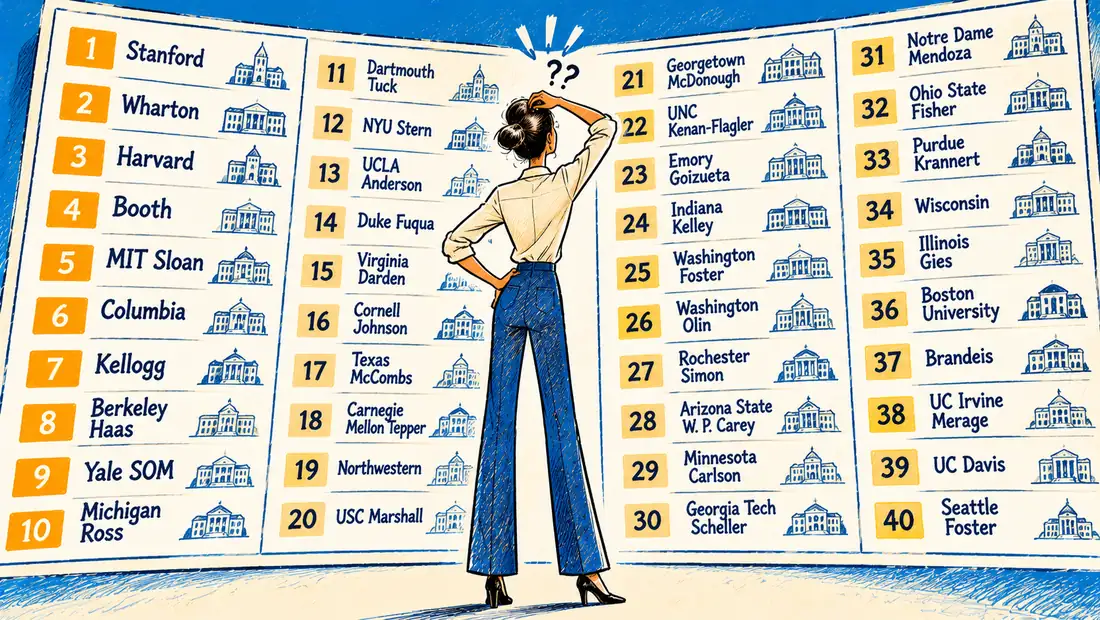

MBA rankings are useful for one thing: sorting schools into broad tiers of reputation and selectivity. The exact order tells you very little, because a move of a few places usually reflects methodology and survey inputs. Choose schools by where their graduates land in your target industry and region, what the program will cost you after scholarships, and whether the culture fits how you learn.
MBA rankings are everywhere, and it is very easy to let them become more important than they should be.
You start by checking where your dream school landed this year, then suddenly you are comparing tiny rank differences, questioning your entire school list, and wondering whether a school ranked seventh is somehow meaningfully better than a school ranked eleventh.
That is where rankings stop being useful and start becoming noise.
The truth is, MBA rankings can give you a broad sense of school reputation, but they are not designed to answer the most important question, which is whether a program is right for you.
This guide will help you use rankings in a smarter way, without letting them make the decision for you.
Prefer to watch? This is the video the article is based on.
The truth about MBA rankings
MBA rankings feel objective because they come with numbers.
But the number itself can be misleading.
A school moving from number five to number eight does not usually mean the education suddenly became worse, or the alumni network collapsed, or employers stopped recruiting there. It often reflects changes in methodology, survey responses, salary inputs, class statistics, or other variables that may have very little to do with your personal outcome.
Rankings still have their uses. They are just not personal.
They are measuring schools from a broad public perspective, while you are trying to make a very specific life and career decision.
Those are not the same thing.
For most applicants, rankings are best used as a rough tiering tool. They can help you understand which schools are broadly seen as ultra-competitive, which sit in the next band, and which may give you stronger admissions odds or scholarship opportunities.
But the exact order matters much less than applicants think.
The better question is, “Which school gives me the strongest path to the career I want?”
Why rankings can still be useful
Rankings do have value when you use them carefully.
They can help you understand general brand strength, admissions competitiveness, and sometimes recruiter perception. They can also help you see whether a school is likely to be considered in the same broad tier as the others on your list.
That is useful information.
But it should be the beginning of the process, not the end.
If you are choosing between programs, ranking should sit alongside much more personal criteria, like industry placement, alumni strength in your target field, geography, scholarship potential, culture, and how well the program supports your specific goals.
A school ranked slightly lower overall may be far stronger for your target industry.
A school outside the top ten may offer a scholarship that changes your ROI completely.
A regional program may have a network that is much more powerful for the city or industry where you actually want to build your life.
That is why rankings can inform the decision, but they should not drive it.
Common ranking mistakes that cost applicants
One of the most common mistakes is chasing tiny differences in rank.
Applicants sometimes turn down a school that is a better fit because another program sits a few spots higher on a list. That can be a real mistake, especially when the lower-ranked school has stronger placement in your target industry or offers meaningful scholarship money.
Another mistake is assuming a higher-ranked school automatically creates better outcomes.
It might. But not always.
If you want West Coast tech, a school with deep Silicon Valley connections may serve you better than a higher-ranked program with weaker access to that market. If you want healthcare, a school with strong healthcare recruiting and regional partnerships may matter more than a slightly stronger overall brand.
The third mistake is treating rankings as a substitute for self-knowledge.
Rankings cannot tell you what kind of environment helps you thrive. They cannot tell you whether you will actually connect with the culture, whether the alumni network is active in your space, or whether the program supports the kind of leader you want to become.
That work still has to come from you.
A better way to choose your MBA program
A smarter MBA school list starts with your goals. Not the rankings.
Start by asking what you are trying to change.
Are you trying to switch industries, move geographies, accelerate within your current field, build a company, or gain access to a specific network?
Once you know that, you can evaluate schools based on whether they support that path.
For example, if your goal is consulting, you want to look closely at consulting placement, club support, alumni access, and recruiting relationships. If your goal is venture capital or entrepreneurship, you want to understand the startup ecosystem, investor access, founder community, and geographic advantages. If your goal is a specific region, you need to know whether the school has power in that market, not just whether it looks impressive nationally.
This is where fit becomes much more important than prestige. By fit I mean alignment, which is different from comfort, or convenience.
The right school should align with your goals, your background, your learning style, your financial reality, and the kind of network you need after graduation.
When you think that way, your school list becomes much stronger.
How to think about reach, match, and safer schools
A strong school list usually includes a mix of ambition and strategy.
You may have a few reach schools, where admission is possible but highly competitive. You may have match schools, where your profile aligns more closely with the typical admitted student. (MBAmo, our free MBA odds calculator, shows where you stand at a target school.) And you may have high-fit schools where your odds are stronger and the outcomes still support your goals.
You are building optionality.
A thoughtful portfolio protects you from putting all your hopes into one or two brands. It also gives you more room to compare offers, scholarships, and long-term fit.
Sometimes the best outcome is not the highest-ranked admit. Sometimes it is the program where you can thrive, access the right opportunities, and graduate with less financial pressure. That is the part rankings almost never capture.
How to evaluate schools beyond rankings
Once you have a broad sense of tiers, go deeper.
Look at career placement data, not just overall salary numbers, but industry, function, and geography. Our free MBA Career Report does this for the top U.S. programs, with each school’s employment data cleaned so you can compare them side by side. A high average salary is useful, but only if graduates are landing in the fields you care about.
Look at alumni activity in your target space. If you want to move into a specific industry, you should be able to find graduates who have already made that move.
Look at culture too. This is harder to measure, but it matters. Some programs are more collaborative, some are more intense, some are more entrepreneurial, some are more traditional. None of these is automatically better, but one may be better for you.
Then look at cost.
Scholarships, living expenses, and opportunity cost can change the ROI picture dramatically. A school that gives you strong outcomes with a significant scholarship may be a better long-term decision than a slightly higher-ranked program at full price.
Prestige still counts. It just belongs in its proper place.
A simple way to reset your school list
If your school list is mostly based on rankings, try rebuilding it from scratch.
Start with your post-MBA goal.
Then identify the schools that have the strongest connection to that goal.
After that, consider your competitiveness, your financial situation, your geographic preferences, and your personal fit.
Only then should you look back at rankings.
When rankings become one input instead of the foundation, your decisions get much clearer.
And your applications usually get stronger too, because you are no longer writing essays about why a school is famous, you are writing about why it makes sense for you.
That is a much more compelling story.
Frequently asked questions
Are MBA rankings important when choosing a business school?
MBA rankings can help you understand broad school reputation and competitiveness, but they should not be the only factor in choosing a business school.
What matters more than MBA rankings?
Career placement, alumni network, geographic strength, scholarships, culture, and fit with your goals often matter more than small differences in MBA ranking.
Should I choose a higher-ranked MBA program over a better-fit school?
Not always. A better-fit school can offer stronger ROI if it has better recruiting access, scholarship support, or alumni strength in your target industry.
How should I use MBA rankings wisely?
Use rankings as a broad tiering tool, then compare schools based on career outcomes, culture, cost, scholarships, and alignment with your post-MBA goals.
Do MBA rankings affect job opportunities?
Rankings can influence brand perception, but employers usually care more about school reputation in a specific field, alumni connections, and your individual profile.
Can a lower-ranked MBA program offer better ROI?
Yes, especially if it offers scholarship money, strong placement in your target industry, or a powerful regional network.
How do I know which MBA program is right for me?
Start with your career goal, then evaluate schools based on placement data, alumni access, location, cost, culture, and your likelihood of admission.
Where can I get help choosing the right MBA program?
Start with the free MBA Career Report, which lets you compare the top U.S. programs’ employment data side by side. The free MBA Momentum Club has lessons on researching programs and rankings and on choosing schools for your career.
MBA rankings are a rough signal, and sometimes a useful one. They cannot tell you where you will grow, where you will get the best scholarship, or where your career goals will be best supported. The right program gives you the best combination of fit, opportunity, affordability, and long-term career value.
Use rankings wisely, but do not let them run your life. Your future deserves more than clickbait math.