

A bonus to the 2026 Career Report · 11 European schools · Class of 2025
European MBA Employment Insights 2026
Eleven top European business schools: who gets hired, what they get paid, and where they end up. A companion to The Super Awesome Official Post-MBA Career Placement Report 2026.
Maybe you’re weighing INSEAD against Wharton, or LBS against Booth. Maybe Europe has been the plan from day one. Either way, you deserve the same straight answers we gave you on the U.S. schools.
So we pulled every employment report these 11 schools published, back to 2019 where we could find them, and put them through the same process as our U.S. report. Same rules: the schools’ own numbers only, nothing estimated, and a note wherever a school counts things differently.
The schools: INSEAD, London Business School (LBS), Cambridge Judge, Oxford Saïd, HEC Paris, IESE, ESADE, IMD, St. Gallen (HSG), SDA Bocconi, and IE Business School.
One warning before you dive in. European schools don’t report the way U.S. schools do. Some count offers received instead of offers accepted. Some publish total pay instead of base salary. One publishes pay only in “purchasing power” dollars. So we kept these numbers apart from the U.S. data, converted every salary to U.S. dollars at one exchange rate per year, and marked every number that isn’t apples to apples. You’ll see the markers. They matter.
The short version
| The question | The straight answer | Your move |
|---|---|---|
| Are European MBAs still getting hired? | Yes, but less easily than a few years ago. In the Class of 2025, 70% to 90% had a job or offer about three months out, depending on the school and how it counts. Most schools with older data started this stretch in the 90s. | Ask each school how it counts. “Received an offer” and “accepted an offer” are different numbers. |
| Do they pay less than U.S. schools? | In dollars, yes. Average base salary for the Class of 2025 ran from about $94,000 to $121,000. At the U.S. schools in our main report it ran from about $121,000 to $190,000. | Compare base salary with base salary. Total pay (‡) includes bonuses and reads higher. |
| Where do graduates work? | Many stay close to the school. 68% of St. Gallen’s class took jobs in Switzerland, and 43% to 48% of the UK schools’ classes stayed in the UK. North America took 3% to 14% at the schools that report it. | Want a U.S. job? A U.S. school is the more direct road. Want Europe, the Middle East, or Asia? Read on. |
| What kinds of jobs? | Consulting dominates at INSEAD, IESE, and LBS. Tech leads at ESADE, HEC Paris, and Cambridge Judge, and finance leads at Oxford Saïd. | Pick the school whose class already looks like the job you want. |
Getting hired: the same tougher market, with a European accent
Hiring cooled in Europe too.
At HEC Paris, the share of the class with an accepted offer three months out slid from 93% in 2021 to 75% in 2025. Cambridge Judge went from 94% employed in 2022 to 73% in 2025. INSEAD went from 94% with an offer in 2022 to 81% in 2025.
LBS held up best of the big names: 90%, then 86% two years running. ESADE has stayed around 90% the whole way. IESE dipped hard in 2024, when 77% had found a job, and 80% had accepted an offer in 2025. Those two count slightly different things, so don’t read the 2025 number as a full rebound.
If that sounds scary, look at the U.S. side. In our main report, 85% of job seekers at the top 10 U.S. schools and 81% at the schools outside the top 10 had accepted an offer three months out in 2025. Europe is in the same territory, in the same market.
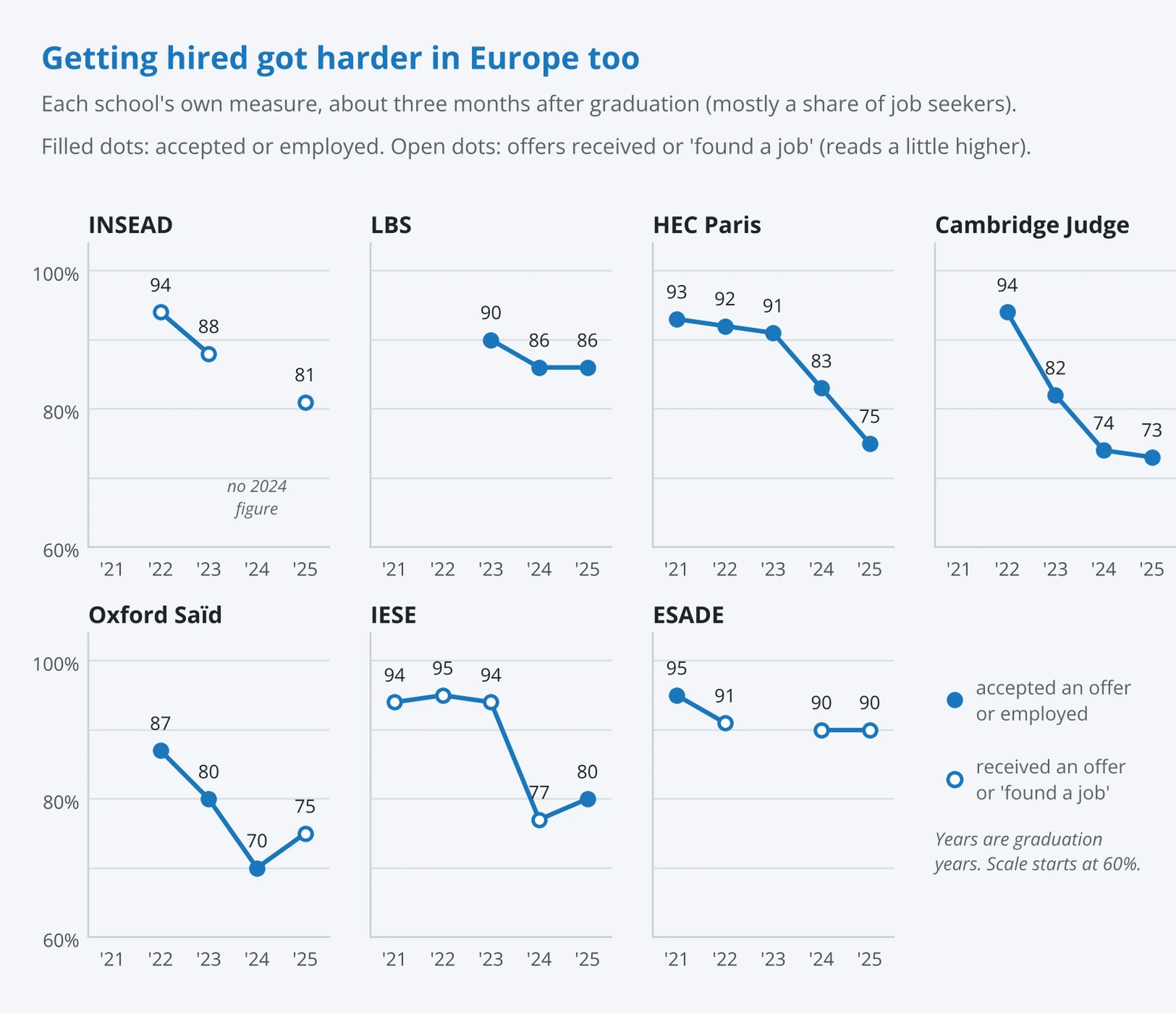
Each school’s own measure, about three months after graduation. Open dots count offers received or “found a job,” which reads higher than accepted offers. IMD, St. Gallen, and SDA Bocconi don’t publish enough comparable years to show a trend, and IE publishes no MBA-only rate.
Data nerd note: INSEAD counts offers received and published no 2024 figure. Oxford’s 2024 rate is a share of all graduates, not job seekers, so it reads lower than its other years. Cambridge publishes “employed,” which we treat like an accepted offer, the same way we treat “employed within 90 days” in the U.S. report.
Pay: lower in dollars, so read the label
In U.S. dollars, a European MBA pays less on day one. For the Class of 2025, average base salary ran from $93,829 at Cambridge Judge to $121,117 at LBS. The U.S. schools in our main report ran from about $121,000 to about $190,000.
Three European schools look higher: IMD ($136,940), SDA Bocconi ($124,153), and HEC Paris ($123,170). Careful. IMD and HEC publish total pay that includes bonuses, and Bocconi calls its figure a “salary package,” so none of the three is apples to apples with base salary. That’s what the ‡ means.
Two more things before you do the math. Exchange rates move: we convert at one average rate per year, so a stronger or weaker euro or pound shifts the picture. And several of these programs take about a year instead of two, which changes what you give up to go.
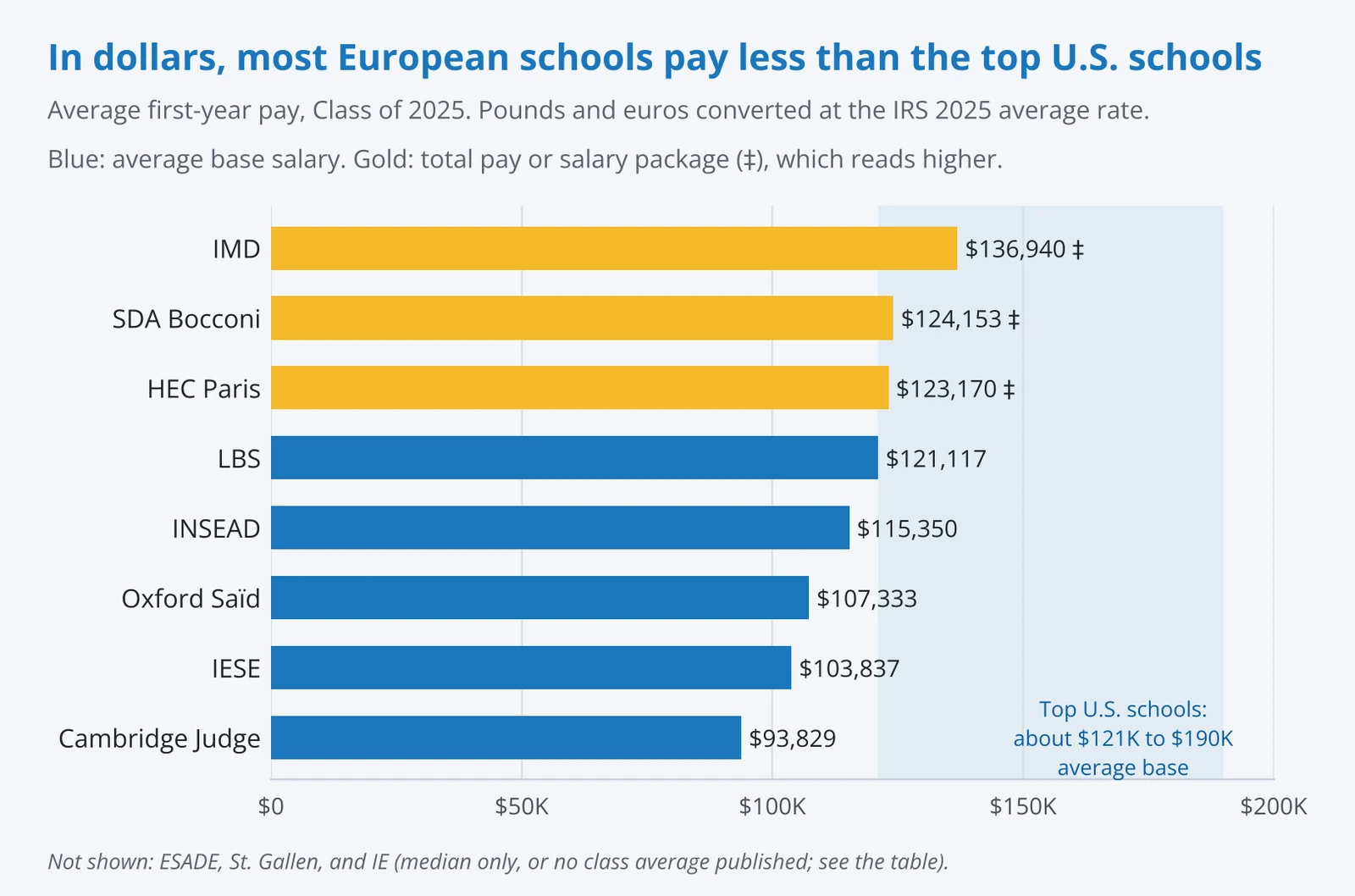
Average first-year pay for the Class of 2025. Pounds and euros converted at the IRS average exchange rate for 2025; HEC Paris and IMD publish in U.S. dollars. ‡ = total pay or salary package, which may include bonuses. St. Gallen publishes a median only (CHF 100,000, about $120,337). ESADE publishes pay only by sector and region, in purchasing-power dollars, so it has no class average.
Your move. Compare base salary with base salary, then look at where the job is. The city you land in can move your pay as much as the school name does.
Consulting rules at the big three. Elsewhere the mix is wider
If consulting is your plan, INSEAD, IESE, and LBS are built for it: 50%, 42%, and 40% of the Class of 2025 went into consulting. One footnote on INSEAD: more than half of that 50% (27 percentage points) were people going back to a consulting firm they’d worked for before the MBA. The door for career switchers is real, just smaller than the headline.
Elsewhere, tech is the biggest single industry at ESADE (35%), HEC Paris (27%), and Cambridge Judge (24%). Finance leads at Oxford Saïd (32%). St. Gallen sends more than half its class into manufacturing (29%) and health care (25%).
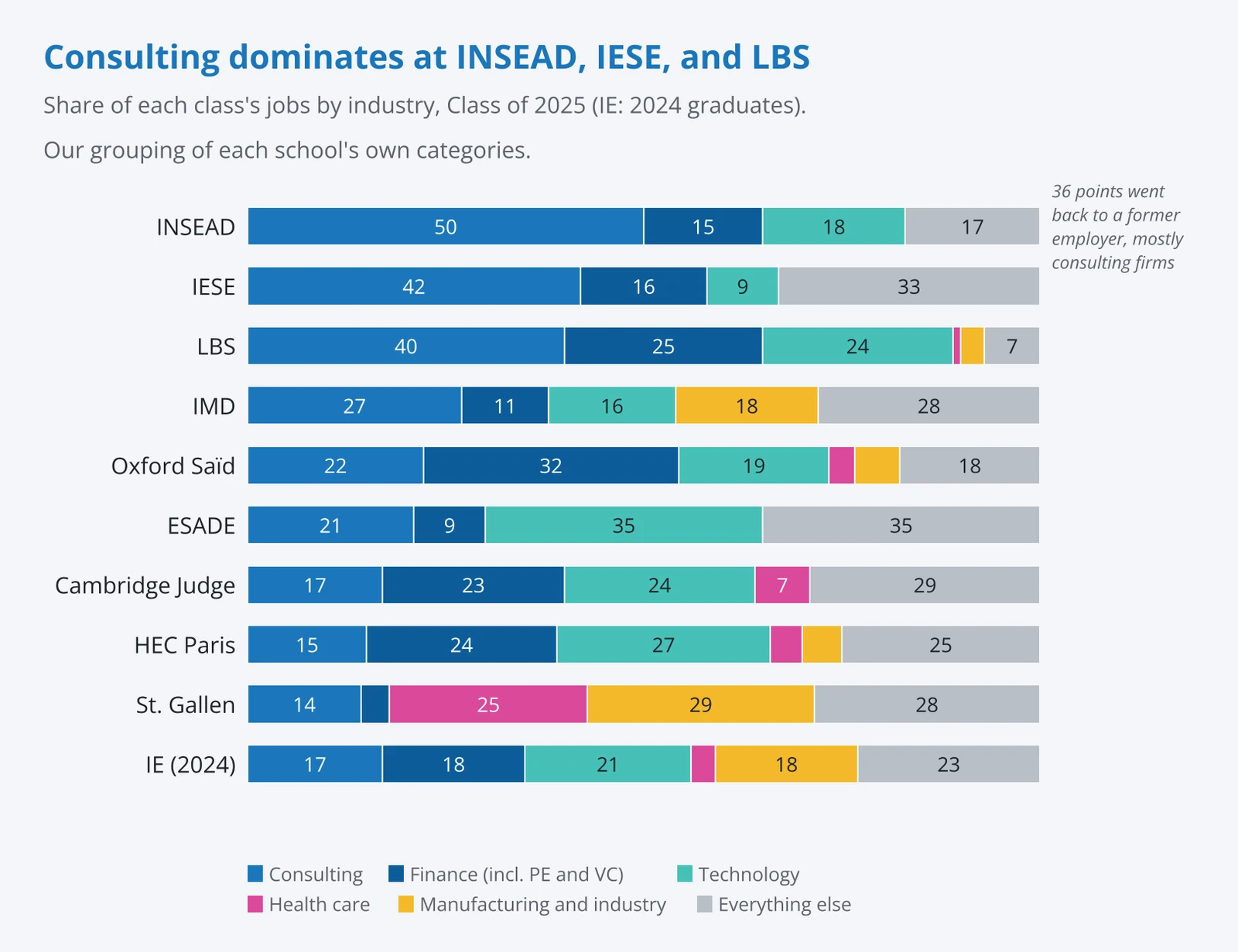
Share of jobs by industry, Class of 2025 (IE: 2024 graduates), grouped from each school’s own categories into the industries we use in the main report. “Everything else” includes catch-all groups a school doesn’t split, like IESE’s “Diversified Industries” (33%). SDA Bocconi isn’t shown: its 2025 page gives the split only as a graphic.
Where you’ll work: often close to campus
Plenty of graduates stay local. 68% of St. Gallen’s class took jobs in Switzerland. At Oxford Saïd, 48% stayed in the UK; at LBS and Cambridge Judge, 43%.
The French and Spanish schools spread out more. HEC Paris placed 26% in France and another 26% elsewhere in Europe. IESE sent 27% to Latin America, more than it kept in Spain (21%).
And North America? Between 3% and 14% at the schools that report it. If your heart is set on a U.S. job, a U.S. school is the more direct road. If you’re aiming for Asia, the Middle East, or Africa, look hard at INSEAD and Cambridge Judge: each sent more than 40% of its class there.
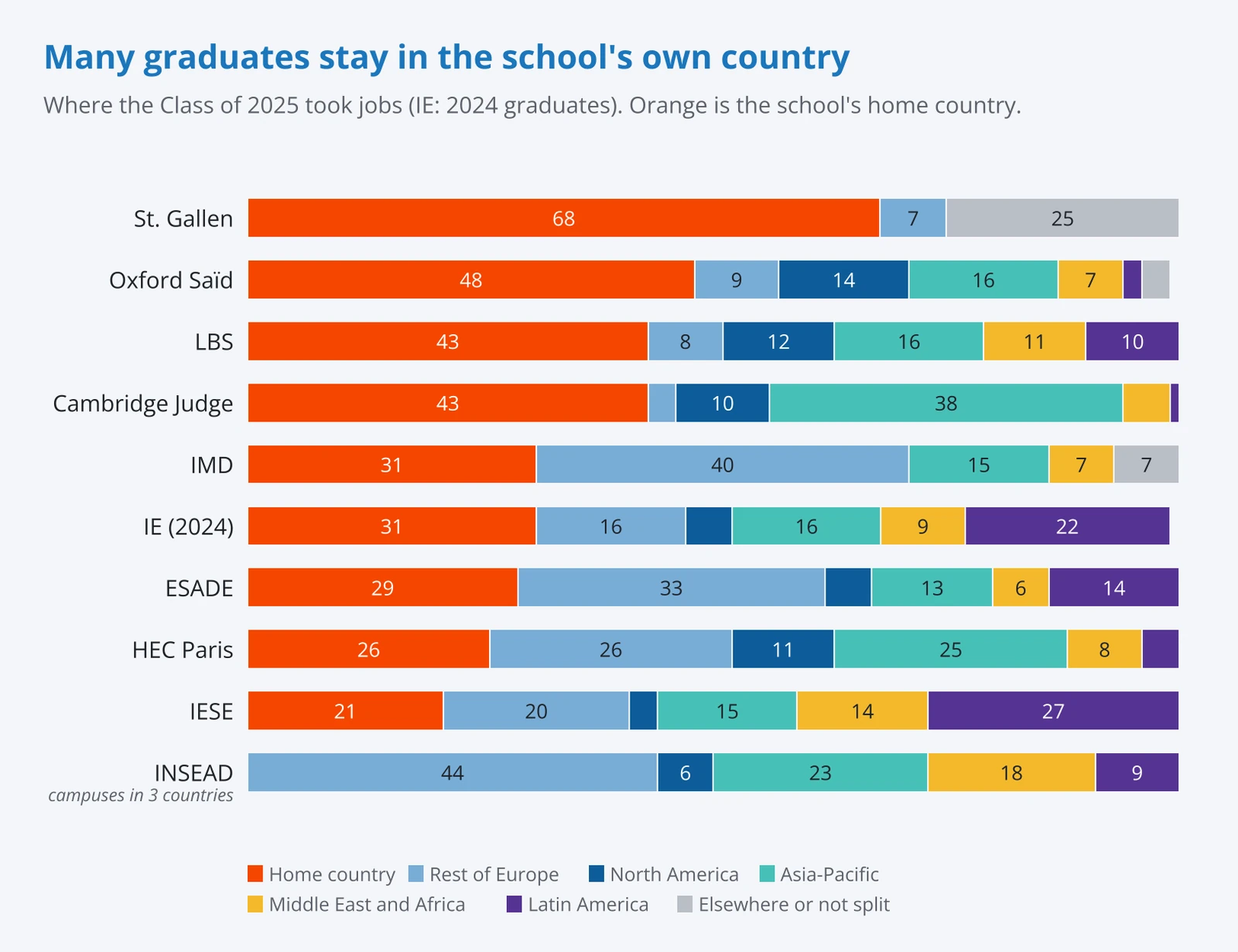
Where the Class of 2025 took jobs (IE: 2024 graduates), grouped into regions. INSEAD has campuses in three countries, so it has no single home country. IMD reports the Americas as one group, and St. Gallen reports “Rest of World.”
Your move. Decide where you want to live in five years. Then shortlist schools whose graduates already work there. Each school’s job-location page is the best map you’ll get.
All 11 schools at a glance
| School | Country | Class size | Job or offer, 3 months | Average pay (USD) | Biggest industry | Stayed in home country |
|---|---|---|---|---|---|---|
| INSEAD | France, Singapore, UAE | 929 | 81% received | $115,350 | Consulting 50% | – |
| London Business School | UK | 488 | 86% accepted | $121,117 | Consulting 40% | 43% |
| Cambridge Judge | UK | – | 73% employed | $93,829 | Technology 24% | 43% |
| Oxford Saïd | UK | 339 | 75% received | $107,333 | Finance 32% | 48% |
| HEC Paris | France | 235 | 75% accepted | $123,170 ‡ | Technology 27% | 26% |
| IESE | Spain | 342 | 80% accepted | $103,837 | Consulting 42% | 21% |
| ESADE | Spain | 162 | 90% found a job | – | Technology 35% | 29% |
| IMD | Switzerland | 78 | 70% accepted | $136,940 ‡ | Consulting 27% | 31% |
| St. Gallen (HSG) | Switzerland | – | 85% received | $120,337 † | Manufacturing 29% | 68% |
| SDA Bocconi | Italy | – | 79% found a job | $124,153 ‡ | – | – |
| IE Business School (2024 grads) | Spain | – | – | – | Technology 21% | 31% |
Class of 2025 unless marked. Pay: average base salary unless marked. ‡ = total pay or salary package. † = median (the school publishes no average). A dash means no comparable figure: INSEAD has no single home country, and SDA Bocconi shows its industry and location split only as graphics. Rates are rounded to the nearest whole percent.
How we built this
Data nerd note: Every number comes from the schools’ own employment reports and career pages, Class of 2019 to Class of 2025 where published. IESE’s 2024 and 2025 reports came to us as copies of IESE’s own documents posted on other sites; the 2025 headline numbers match IESE’s own Annual Report 2025.
Data nerd note: Salaries are converted to U.S. dollars at the IRS yearly average rate for the graduation year. We skip the schools’ own converted dollar and purchasing-power figures, so every school is converted the same way. HEC Paris and IMD publish in U.S. dollars, so their figures are used as printed. Industries are grouped into the 16 industries of our main report.
Data nerd note: Some years are missing because the school didn’t publish them where we could find them: INSEAD 2024 (only a median salary and job locations), IMD 2024, SDA Bocconi 2024, St. Gallen 2024, IE 2025, and ESADE 2023. None of these numbers are mixed into the U.S. report.
Now what?
If you’re weighing Europe against the U.S., or one European school against another, you’re doing exactly the homework this decision deserves. We work with applicants on both sides of the Atlantic, and we’d love to hear where you’re headed.
Want the full U.S. picture? The Super Awesome Official Post-MBA Career Placement Report 2026 covers 29 top U.S. schools, chart by chart and school by school.
Want to know which companies hire from these schools? MBA Recruiters at European Business Schools lists 2,737 employers from the schools' own lists, with a page for each school.
Questions about European MBA jobs and pay
Do European MBA graduates still get hired?
Yes, though less easily than a few years ago. In the Class of 2025, 70% to 90% had a job or offer about three months after graduation, depending on the school and on how it counts.
Do European MBAs pay less than U.S. MBAs?
In U.S. dollars, yes. Average base salary for the Class of 2025 ran from about $94,000 to $121,000 at these schools, against about $121,000 to $190,000 at the 29 U.S. schools in our main report.
Which European MBA is best for consulting?
INSEAD, IESE and LBS: 50%, 42% and 40% of their Class of 2025 went into consulting. At INSEAD, more than half of those returned to a firm they had worked for before the MBA.
Can a European MBA get you a job in the U.S.?
Some graduates do, but between 3% and 14% took jobs in North America at the schools that report it. If a U.S. job is the goal, a U.S. school is the more direct road.